The World Tree in Norse myth and in the MCU
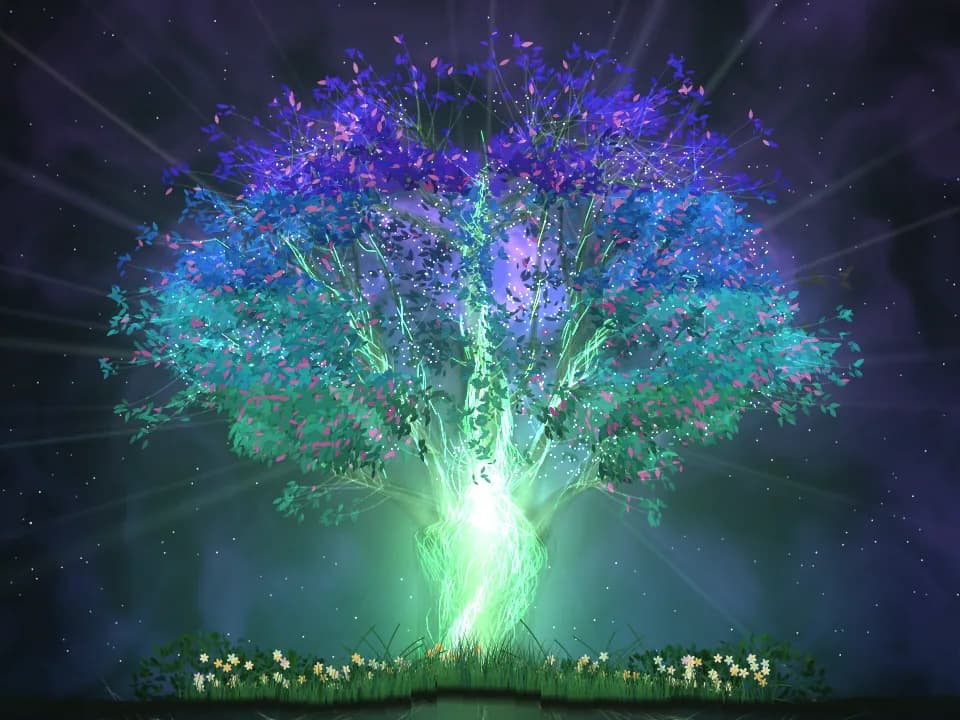
Yggdrasil is the World Tree of Norse myth: a vast ash whose roots and branches hold the worlds together, with the gods meeting at its foot every day. The MCU has used it twice in a big way. In Thor, it’s the tree whose branches link the Nine Realms. In the Loki season 2 finale, it’s what every timeline becomes when Loki takes hold of them at the End of Time.
That second tree is the one on this site: every Marvel timeline as one tree, which grows as you watch. Here’s where it comes from.
Nearly everything we know about Yggdrasil comes from two books written down in Iceland in the 1200s, a couple of centuries after the island became Christian. The Poetic Edda collects older, anonymous poems: the Völuspá, a seeress’s vision of the world from its making to its end, describes the tree, and the Grímnismál and the Hávamál fill in the rest. The Prose Edda, written by Snorri Sturluson around 1220, retells the myths as a handbook and adds a lot of the detail.
Nine worlds I knew, the nine in the treeWith mighty roots beneath the mold.
An ash I know, Yggdrasil its name,With water white is the great tree wet
Snorri gives it three roots, each over a well. One reaches the gods, the Æsir, over the well of Urð, and the gods ride across Bifröst every day to hold their court there. One reaches the frost giants, over Mímir’s well, where wisdom is hidden: Odin gave one of his eyes for a single drink from it. The third reaches over Niflheim, the world of cold and mist, above the spring Hvergelmir, where the dragon Níðhögg gnaws at the root. The Grímnismál divides it differently, with Hel under one root, the frost giants under another and humankind under the third. The sources don’t always agree.
It’s also crowded. An eagle sits in its highest branches, with a hawk called Veðrfölnir perched between its eyes. A squirrel, Ratatosk, runs up and down the trunk carrying insults between the eagle and Níðhögg. Four stags, Dáin, Dvalin, Duneyr and Durathrór, graze on its highest shoots, and more serpents lie under it than a fool would imagine. The Grímnismál says the ash suffers more than anyone knows: a stag bites it from above, it rots at the side, and Níðhögg gnaws it from below.
At the well of Urð live the Norns, three women who shape the lives of people, named in the Völuspá as Urð, Verðandi and Skuld. Every day they take water from the well, with the white clay around it, and pour it over the ash so that its branches don’t wither or rot. The dew that falls from it, Snorri says, is what people call honeydew, and bees feed on it.
Most scholars read Yggdrasil as “Ygg’s horse”. Yggr, “the terrible one”, is one of Odin’s many names, and drasill is a poetic word for a horse. In Norse poetry a gallows could be the horse of the hanged, and in the Hávamál Odin hangs on a windy tree for nine nights, wounded by a spear, given to Odin, himself to himself, until he takes up the runes. The poem never names the tree, but nearly everyone takes it to be Yggdrasil: the World Tree as Odin’s gallows, and his steed.
Not everyone agrees. F. Detter read the first half as plain yggr, “terror”, making it the tree of terror. F. R. Schröder proposed “yew pillar”, from an old word for the yew. Neither has displaced Odin’s horse.
The centre of everything. Snorri calls the ash the holiest place of the gods, where they hold court every day, and it holds the nine worlds in its roots and branches. Scholars call this kind of tree an axis mundi, the pillar at the centre of the world, and world trees that join the worlds above and below turn up across Northern Europe and Asia, in Siberian shamanic traditions among others.
A tree of fate. The Norns at its foot shape every life, and keep the tree itself alive.
A tree of sacrifice and wisdom. Odin’s nine nights on it win him the runes, and his eye buys a drink from the well beneath it.
A tree that suffers and survives. It’s bitten, gnawed and rotting, and at Ragnarök it shakes. But it stands. Two people, Líf and Lífthrasir, hide through the end of the world in Hoddmímir’s wood, which many scholars read as the tree itself, and the world is peopled again from them.
Yggdrasil shakes, and shiver on highThe ancient limbs, and the giant is loose
And real trees. In the 1070s Adam of Bremen described a huge tree beside the temple at Uppsala in Sweden, green in summer and winter, with a well beside it. The Saxons honoured the Irminsul, a great pillar that Charlemagne destroyed in 772. Scholars see the same idea behind both: a sacred centre, and somewhere behind it, Yggdrasil.
Thor (2011). Stranded on Earth, Thor sketches the cosmos in Jane Foster’s notebook the way his father taught him: “your world is one of the Nine Realms of the Cosmos, linked to each other by the branches of Yggdrasil, the World Tree.” Midgard is Earth, and Alfheim, Vanaheim, Jötunheim and Asgard hang in the branches with it. It’s also where the films set out how Asgard works: “Your ancestors called it magic and you call it science. Well, I come from a place where they’re one and the same thing.”
Thor: The Dark World (2013) turns on the same cosmology. The Convergence is a rare alignment of the Nine Realms, when the walls between them wear thin and portals open at random, and Malekith means to unleash the Aether at the heart of it.
The myth’s gods cross Bifröst to reach the tree every day; the films’ Asgardians cross it to reach the realms. Marvel kept the shape, a tree holding worlds together, and made it a map.
Spoilers for the end of Loki season 2, and of What If…? season 2. Switch them on above to read.
Loki season 2, episode 6, “Glorious Purpose” (2023). The Temporal Loom can’t hold the branching timelines, and they’re dying. Loki destroys the Loom, takes hold of the dying timelines with his magic, and walks them to the End of Time, where they grow into a vast tree around him, unmistakably the World Tree, with Loki on a throne at its heart, holding every timeline together. The episode shares its title with the very first episode of the series, on purpose: it’s the glorious purpose Loki was always talking about.
What If…? season 2, in its finale (2023). When the Watcher takes Captain Carter home the scenic route, the multiverse he shows her has the same shape: Loki’s tree.
Our Yggdrasil takes the Loki finale at its word. Every Marvel film and show on the road is a thread of light, and the threads are the tree: the Sacred Timeline climbs the middle in story order toward Avengers: Doomsday, and every other world is a bough of its own, from Fox’s X-Men to Sony’s Spider-Man films, the Spider-Verse and Venom’s world. Watch a title, and its thread lights up from the ground to its leaf.
It’s free. Watch a tenth of what’s out and it unlocks, along with the GLORIOUS PURPOSE badge; account holders can open it any time. Open Yggdrasil.
