
The full story
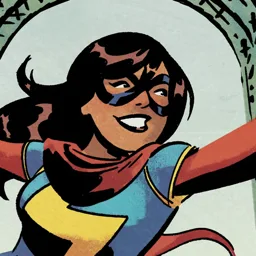
Ms. Marvel is structured as a generational story, beginning with Kamala Khan but reaching backward to her grandmother and forward to what Kamala will become. The series is about the inheritance of both power and identity—the ways that what comes before us shapes who we are and who we choose to become.
Kamala is caught between two worlds. She is American—she speaks, thinks, and dreams like an American teenager. She consumes American pop culture. She wants normal American experiences. She is also Pakistani—her family has traditions, expectations, and values rooted in a different cultural context. She loves both and feels alienated by both because she cannot fully inhabit either. She is perpetually caught between, and the series does not offer the comfort of integration. It shows the genuine tension of dual identity.
When Kamala discovers her powers, she initially experiences them as coincidental to her identity. They simply happen to be present in her body. But the series reveals that her powers are inherited—they come from her grandmother, from an event during Partition when her grandmother was given an amulet by a mystical being. The power and the identity are inseparable. To claim the power, Kamala must also claim the history and the responsibility attached to it. She cannot have the superhuman abilities without the cultural connection.
Sana, Kamala's grandmother, fled Partition, a historical event where India was divided into India and Pakistan, displacing millions of people. The trauma of Partition is inscribed in Kamala's family history. It lives in her grandmother's silences, in the stories that are not told, in the weight of survival carried by her family line. When Kamala discovers she has powers connected to Partition, she is being told that she cannot escape history—it is literally encoded in her blood.
Muneeba, Kamala's mother, represents a different approach. She has tried to fully assimilate into American culture, to create a family that is American first and Pakistani second. She has controlled Kamala tightly, trying to protect her from the messiness of dual identity. When Muneeba discovers Kamala's powers, she must confront that she cannot protect her daughter from her own inheritance. It is too deeply embedded.
The series does not suggest that embracing cultural identity is easy or pure. Some of Kamala's heritage is beautiful. Some of it is constraining. Some of it is both simultaneously. The series shows her learning to navigate that complexity, to claim parts of her inheritance while questioning others, to be Pakistani-American not as a compromise but as a legitimate identity that requires integration, not selection.
By the series' end, Kamala has accepted that she is the inheritor of a complex legacy. She has power, yes, but more importantly, she has a family history that she did not choose but which she now must carry forward. She will make different choices than her grandmother made. She will question things her mother has accepted. But she will do so as someone shaped by both of them, inheriting not just their trauma but their courage, not just their constraints but their resilience.